Fugazi: Anthony's Album Guide
GLIB XENNIAL ALERT: If you don't know the history of hardcore punk in Washington, DC, and its various subcultural offshoots, visit your local library or bookstore and read Dance Of Days, by Mark Andersen of Positive House DC. It's a terrific, on-the-ground look at the highs and lows of trying to enact positive change in a deeply troubled, historically segregated area in the late 20th century, while also trying to rock out awesomely. This post will be awfully reductive in comparison. My handy dandy profoundly subjective numerical rating scheme is explained here.
13 Songs (1989) 9
Repeater (1990) 8
Steady Diet Of Nothing (1991) 8
In On The Kill Taker (1993) 8
Red Medicine (1995) 7
End Hits (1998) 8
Instrument OST (1999) 6
The Argument (2001) 9
Dave Grohl and Henry Rollins aside (their connections more of a fun fact than primary claim to fame), the most recognizable veteran of HarDCore is Ian MacKaye. Raised in a family of politically conscious, writerly Episcopalians, MacKaye latched on to punk in his teens, excited by a combination of hard riffs and unapologetic, independent thought, with far more progressive potential than the Ted Nugent he’d previously settled for. While his curly hair denied him a mohawk, the burgeoning hardcore movement encouraged shaving it all off anyway. ("Hardcore" punk basically meant being even more punk than The Ramones in terms of volume, speed, violence and standing in opposition to mainstream society. Anything to not be mistaken for “new wave”).
Footage from Minor Threat's failed audition for The New Monkees.
MacKaye and drummer Jeff Nelson created Dischord Records to release the work of their already defunct Teen Idles, before founding Minor Threat, maybe the best American hardcore band in terms of musical attack and a clear, adamant expression of outrage over peer pressure, fake friends, a conformist society, and uh…getting beat up by black classmates even though you’re anti-racism (they were really young). Quickly, however, the musical 3/4ths of Threat were tired of the scene’s violence and purity testing, suggesting U2 as a model for artistic and commercial evolution. MacKaye passed, and Minor Threat was dunzo by the end of 1983, leaving behind a CD’s worth of memorable songs and some legendary images you’ve likely seen referenced by worse bands and shameless sneaker companies.
Eager to grow past the aesthetic confines of hardcore, without surrendering the political mission, the true believers around Dischord got a creative second wind in 1985, centered around the concept of “Revolution Summer.” MacKaye teamed with the instrumental combo of his brother Alec’s band Faith to start Embrace, a less manic, but no less intense response to the internal and external frustrations of early adulthood. Arguably even more exciting was Rites Of Spring, a slightly younger quartet, whose singer Guy Picciotto was more poetic, and far less macho, than the average mosh-leader. The wailing passion of these bands and their fans inspired the derogatory term “emo,” less enraptured witnesses confused by the kids crying along to every word.
If this doesn't make your rip your shirt off and bawl, maybe you had to be there.
While that archetype would eventually have its own journey through pop culture, Rites Of Spring and Embrace were brought down by the usual in-fighting and defections to college, both bands again leaving us with one great record and some exploitable iconography. Feeling truly “fool me twice, shame on me” about the whole thing, MacKaye was determined his next act would be a more enduring concern. He would play guitar and sing, cutting his bandmate needs by a third. He then met Joe Lally, a like-minded, drama-free bassist. Months of practice followed before they locked in with Rites Of Spring drummer Brendan Canty, more months of practice coming before their first show in late ’87, as Fugazi.
Picciotto, who’d never been in a band without Canty, skulked around Fugazi practices long enough to become part of the act. Initially, the trio having built a thick, full sound you could almost call "heavy reggae" (MacKaye’s stentorian sea chanty vocals thankfully devoid of patois), Picciotto only added background shouts and the occasional lead vocal, positioning himself as a Flavor Flav-type hype man. But by the recording of 1988’s self-titled EP, Picciotto was singing even more than MacKaye. His contributions included sneering demands for an AIDS cure, an agonized portrait of addiction and “my analysis: it’s time to harvest the crust from your eyes!” These snarls and sighs are oddly erotic and playful despite their fury, but make more sense once you learn he's a big Queen fan.
Fugazi and Amy Pickering do "Suggestion" at one hell of a hometown gig, 1988.
MacKaye still handled the most legendary tracks. The statement of intent “Waiting Room,” a rap-reggae-rock hybrid as patient as it is potent, rolls so naturally there’d be no reason to bring up Big Audio Dynamite (today it even serves as a jock jam at DC sporting events). “Suggestion,” a condemnation of rape culture, was partly sung from the perspective of a female sexual assault victim. Recognizing the possible accusation of political co-option, Fugazi would have Fire Party’s Amy Pickering sing it live whenever possible. But this furious expression of empathy was arresting and atypical all the same.
The 1989 EP Margin Walker was in actuality the acceptable tracks from an aborted debut LP recorded in London, but it makes for a fine second half of 13 Songs, a CD compilation of both EPs released later in the year. The woodshedding had paid off big time, “And The Same” even more mammoth and righteously indignant than Husker Du, thoughtfully melding dub and punk-metal like Bad Brains never got a chance to. The authoritative crunch is up there with Van Halen and Black Sabbath as far as era-defining debuts go, the back-and-forth lyrical barrage recalling The Clash. I don’t love the phrase "post-hardcore” for the sound, and they had too many peers to say Fugazi invented it (including acts like Fire Party and Soulside in DC alone). But MacKaye had finally managed to launch a band with a definitive statement, rather than end with one.
Another guitar in the mix at another wild DC show, 1991.
Perhaps tired of dancing (or rather, tired of just dancing), Picciotto realized his guitar could fill in the high end beside MacKaye’s, much like their voices. The fully-fledged quartet could now truly jam, collectively building and branching off the established sound. 1990’s Repeater, their first real-deal full-length, crackles with the awareness they’re working on all cylinders, well past the waiting room. A slow-building demand to get out of bed leads to the live-band Bomb Squad squalls of the title track, its obscenely whimsical chorus joined to a bridge chiding fear-based isolation. Song after song bounds and booms defiantly against commercial culture and the excuse of conventional wisdom. Politically, this was no big deal for anyone who’d heard of Maximum Rock & Roll. The novelty was in how unabashedly infectious and invigorating the music was around those hollers.
It now being the ‘90s, major labels were frothing to sign Fugazi. Not only did they reject such advances, the band wouldn’t sell merchandise at shows, or even make anything to wear. They insisted on a $5 cover for shows, strictly all-ages, finding alternative venues if the big clubs refused. They undercut store mark-ups by putting the mail order price on album artwork. They wouldn’t give time to media companies they found complicit in co-opting culture or selling vice. They didn’t even spend ten of thousands to give a video to 120 Minutes! Though Fugazi swore up and down they were merely using the power of "no" to avoid headaches as anyone could, rather than inventing a doctrine, that didn’t stop the dubious from writing how Fugazi thinks they’re so great, ads for bootleg “This Is Not A Fugazi Shirt” shirts in the back classifieds of magazines.
Hometown gigs now on the US Capitol Plaza, 1992.
Maybe a little defensive themselves, the self-produced Steady Diet Of Nothing is recognizably the same band, but steelier and angrier. The sheets of guitar noise hit like a bracingly cold shower, rather than a strong cup of coffee. The musical drama remains gripping, but MacKaye is running out of ways to encourage protest. His best track is a rueful break-up ballad, “Long Division.” While Picciotto’s still got the juice, he also judges your business suit twice. “Dear Justice Letter,” a contemptuous valentine to Walter Brennan for letting George Bush pick his Supreme Court replacement, would make a fine finale. Instead, MacKaye returns to note we must we must we must (we must!) keep our eyes open. Gotcha.
Ironically, many eyes got starry in the underground when Nirvana (featuring the aforementioned Grohl from ex-Dischord act Scream) went to number one, and a Democrat was elected president for the first time since the Teen Idles. Eddie Vedder of Pearl Jam wrote a pro-choice essay named after Fugazi’s "Reclamation" in Spin, one of the magazines Fugazi wouldn’t let interview them. They were also a large part of the sonic formula behind Rage Against The Machine, whose debut album came out on Epic, MTV frequently playing their tribute to political prisoner Leonard Peltier. Should they have gone major?
They played other towns, too!
If these cultural shifts weren’t discombobulating enough, no one in Fugazi had played in a band that made two albums, let alone a third. Sessions with fellow indie iconoclast Steve Albini (months before he recorded PJ Harvey’s Rid Of Me and Nirvana’s In Utero) struck the band as too far down the dry, austere path they’d been on. Instead, they re-recorded what became 1993’s In On The Kill Taker with Repeater co-producer Ted Niceley. Their on-stage improvisation (no setlist!) informed extended feedback-fests like “23 Beats Off,” while cryptic lyrics and enunciation-indifferent vocals required looks at the liner notes, lest you mistook the “wipeout! wipeout!” in “Smallpox Champion” for “white power! white power!” (like a friend feared) or “waffles! waffles!” (like I briefly imagined). Though hardly a pop move, Taker was still a turn back towards anthemic joy, “Public Witness Program” even featuring hand claps. However unimpressed Fugazi were by the alt-rock gold rush, they weren’t going to deny themselves or their audience catharsis. “You’d make a great cop,” MacKaye screams at an interrogator, suggesting - despite Fugazi's request audiences dance rather than mosh - that he’d prefer not to be one.
When Kill Taker cracked the Billboard 200 despite themselves, industry bigwigs like Ahmet Ertegun waved eight-figure checks in MacKaye’s face, offering to buy Dischord, to let him start a boutique label, whatever he wanted. Lollapalooza even asked Fugazi to headline! Though they continued to respond with a polite “no, thank you,” not everyone in the scene abjured the offers of increased income and exposure. By 1994, Dischord bands like Shudder To Think and Jawbox would sign to Epic and Atlantic, respectively. That was also the year Kurt Cobain died, Dave from Scream drummed with Tom Petty on SNL, and Woodstock ’94 confirmed the new commercial normal. There was one rock cliche Fugazi did indulge: jamming for a couple months in a nice Connecticut country house. Hey, it was their royalties!
You think Fugazi weren't fun? They led handclaps!
1995’s Red Medicine features interstitial blurts from those sessions, as well as more traditional recordings engineered by Dischord credit regular Don Zientara. Highlights like “Bed For The Scraping” (“I don’t wanna be defeated! I don’t wanna be defeated!”) and “Target” (“I hate the sound of guitars/ a thousand grudging young millionaires”) are as spirited as ever, but large swaths of the more “experimental” tracks are less The American Clash than familiar indie rock. Is letting the bassist debut as a lead vocalist on the longest track even an experiment, or just filler? Still, the album ends on a promising note, “Long Distance Runner” an eerie, trudging sequel to “Waiting Room,” reaffirming MacKaye’s commitment to independence and endurance.
A long-ass tour was followed by another long-ass stretch of recording, End Hits not showing up until early 1998. The alterna-boom was collapsing, their old Dischord pals quickly dropped as multi-platinum acts suffered flop follow-ups. This might be why Fugazi seems more relaxed than ever, playing with room sound and drum layering. Even the token Joe Lally vocal, “Recap Modotti,” is a groovy gas. There’s still an arty obtuseness to the project, but an enthusiastic one compared to Red Medicine (check out those Sonic Youth squeals opening “Guilford Fall”!), like they’re happy to be a great indie rock band among the era’s many great indie rock bands. The sound of guitars held promise again.
They hid their "Beth" on a documentary soundtrack, and it still became a 100m stream hit.
As celebrated in Jem Cohen’s thoroughly abstract documentary Instrument (its demo-built soundtrack featuring the brief piano ballad “I’m So Tired,” now second only to “Waiting Room” in streaming popularity), Fugazi had thrived across an entire decade, establishing themselves as an exceptional live band with a considerable songbook and an honorable, inspiring commitment to ideals. Nonetheless, real life came calling circa Y2K, drummer Brendan Canty realizing fatherhood and their intense practice/touring schedule wouldn’t mix. Ahmet Ertegun was hanging out with Kid Rock now, the musical landscape under and above ground unrecognizable from the ones that bred and bedeviled them. So, with no chance of getting too big commercially, why not risk it all musically?
And so they did on 2001’s The Argument, an album I’ve tried to sell to skeptics as Fugazi With Capes. After a snatch of cello(!), Ian MacKaye paints a portrait of gentrification’s victims as starkly as he’d said anything in a decade, the band crashing in with strings for a chant of “everybody wants to live!” When that’s over, the guitars turn into hummingbirds of death over doubled drums, Picciotto frantically repeating “I want out!” for a half-minute as a verse, wife Kathi Wilcox of Bikini Kill and Bridget Cross of Unrest cooing behind him on chorus. “Epic Problem” wreaks a rumbling havoc similar to System Of A Down’s 2001 album Toxicity (seriously!), and Guy’s Angels return to harmonize and hand clap on the hypnotic “Life And Limb.” As there’s no sitar mentioned in the credits, I have to assume we’re hearing fake sitar during the grand coda of “Strangelight.” Fake sitar. On a Fugazi album!
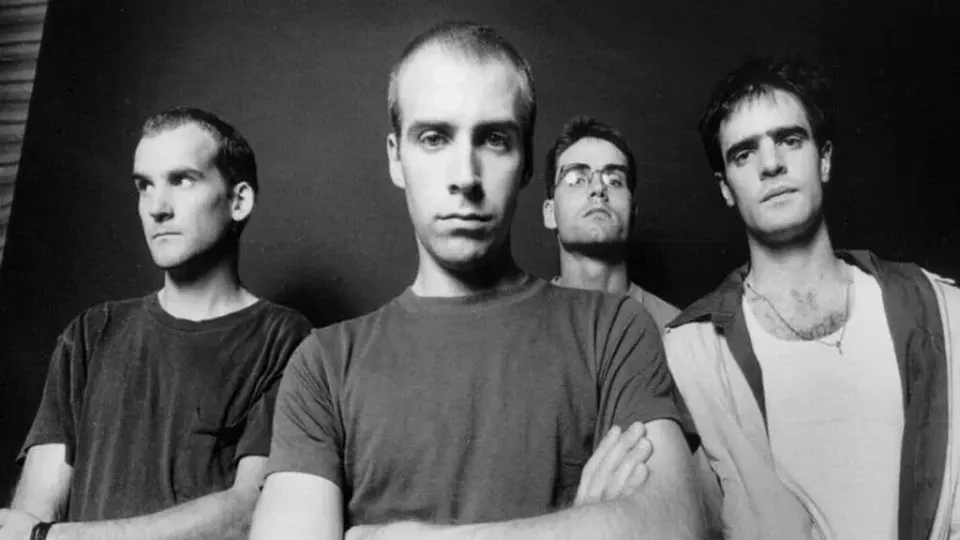
Fugazi announcing "The Argument" in 2002. Note the extra percussion!
Lest it sound like The Argument is merely a post-hardcore Sgt. Peppers’, MacKaye also contributes some of his strongest, most straightforward lyrics. “Epic Problem” and “Ex-Spectator” burn with the mature realization that cultural reform and personal growth will feel Sisyphean until you accept these are practices you commit to for life, rather than a race with an end goal. Thankfully, Picciotto’s more picturesque counterpoints evoke the rapture capable when losing yourself in the work. But MacKaye's titular finale presciently takes all those earlier scene squabbles and debates over punk’s promise as prelude to what’s coming. “Punk” is actually used derogatorily, to describe a person debating “some moral ABCs, when people are catching what bombers release.” The quarter century since its release, with neoliberal cynicism, capitalist nihilism, and digital noise ever more transparently toxic, gives credence to his sing-song of “here comes the argument!” The song’s resounding final note is suddenly cut short by Canty’s hi-hat, the 20th century’s coffin sealing shut.
A relatively modest number of shows followed, and it soon became clear these guys were on the indefinite hiatus to beat all indefinite hiatuses. MacKaye would start The Evens with drummer/wife/co-parent Amy Farina, Lally joining them on bass for an album as Coriky. Lally also made some solo albums, became a dad, and joined Canty as the rhythm section of jazz-rockers The Messthetics. Picciotto produced the Gossip, played guitar with Vic Chesnutt and Jim White, sometimes spotted on podcasts and at basketball games while raising kids with Wilcox in New York. His singing career has ended almost entirely, and I swear that dude must either have passive income or be a secret day trader.
Ian MacKaye: ice tea drinking MFer
Despite, or because of, absurd fantasies from fans that a Fugazi reunion would save us all, the foursome have politely passed on all pleas and festival offers, though they have shared old demos and lots of concert recordings. Perhaps they recognize their dadbods couldn’t handle the physical requirements of American Clashhood even if their schedules open up thanks to empty nesthood. That said, if you’re ever walking in a serene DC area neighborhood one afternoon, and think you hear the dream of the ‘90s at its most galvanizing from a nearby garage, it’s reportedly possible these four pals from way back are indeed having a jam. Don’t be a dick and post footage online, though. Just feel blessed.
The Argument, 13 Songs and Repeater are respectively at 19, 171 and 301 on My Top 400 Albums Of All Time. I'm telling you this because I've found people are more inclined to discuss and share reviews if there's a quantitative element at the top or bottom they can easily debate. Prove me right! All raves, requests and recriminations can go to tellyourfriend fuckyou...kidding. Anthonyisright at gmail dot com. That's my email.