My Favorite Albums Of 1971
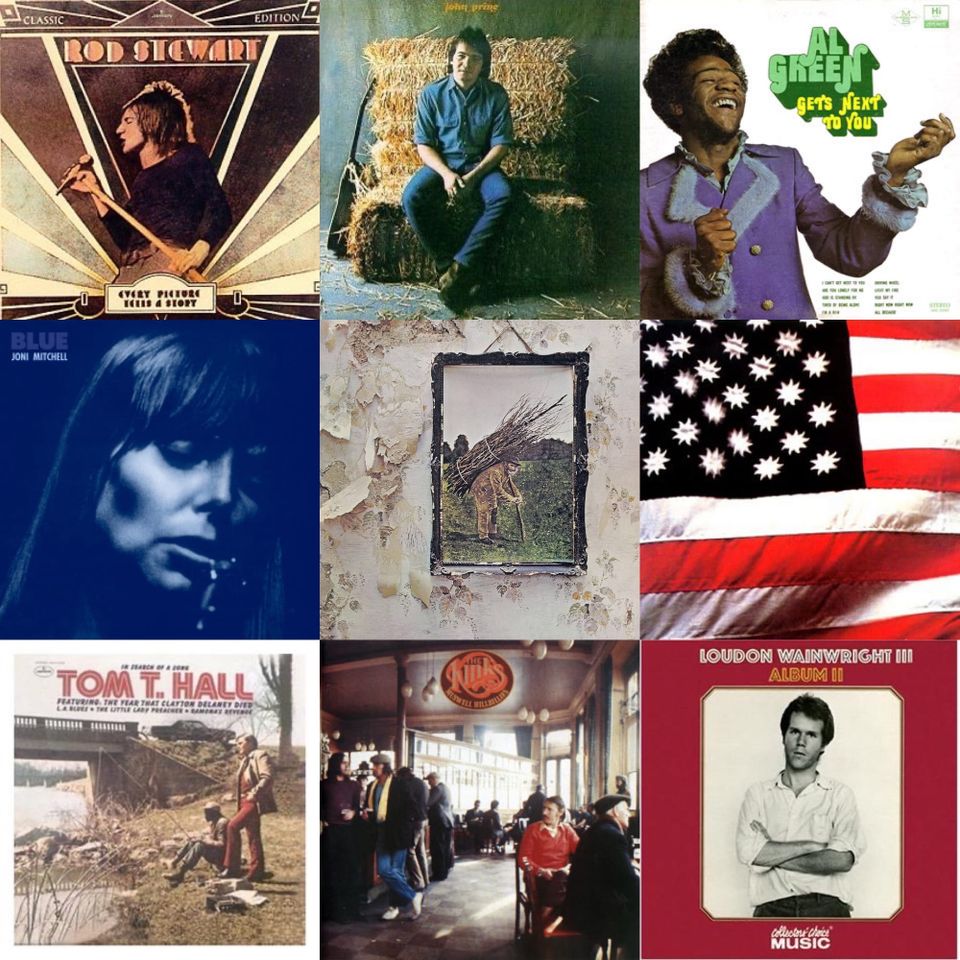
1971! I wasn't there, but I've found thirty albums released that year I'd keep on the shelf anyway. Here's the Top Ten!
1. Rod Stewart, Every Picture Tells A Story
"...music as mighty and majestic as Led Zeppelin or the Stones, with none of the self-serious preening."
 Anthony Cougar Miccio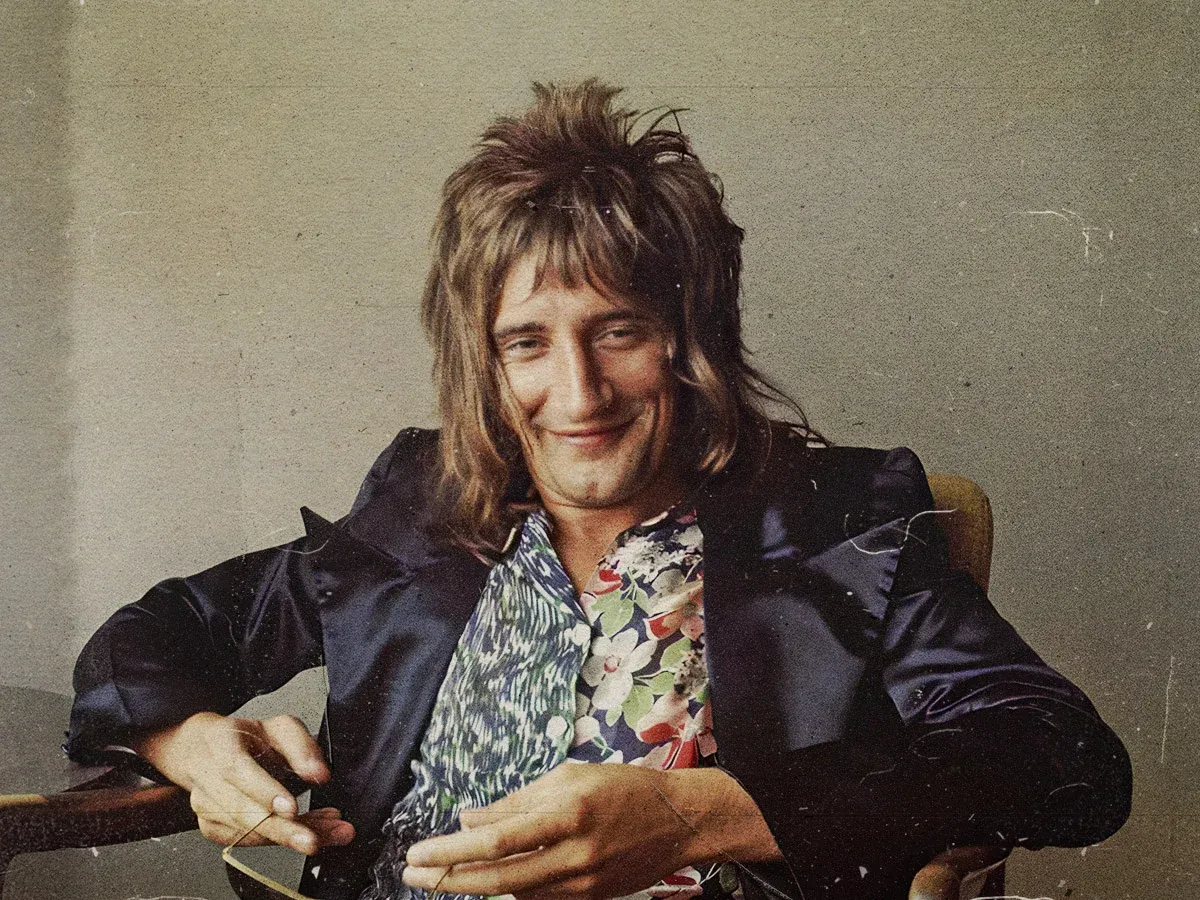
2. John Prine, John Prine
"...an even more staggering songbook than The Freewheelin’ Bob Dylan, its breadth hidden by unassuming empathy."
Anthony Cougar Miccio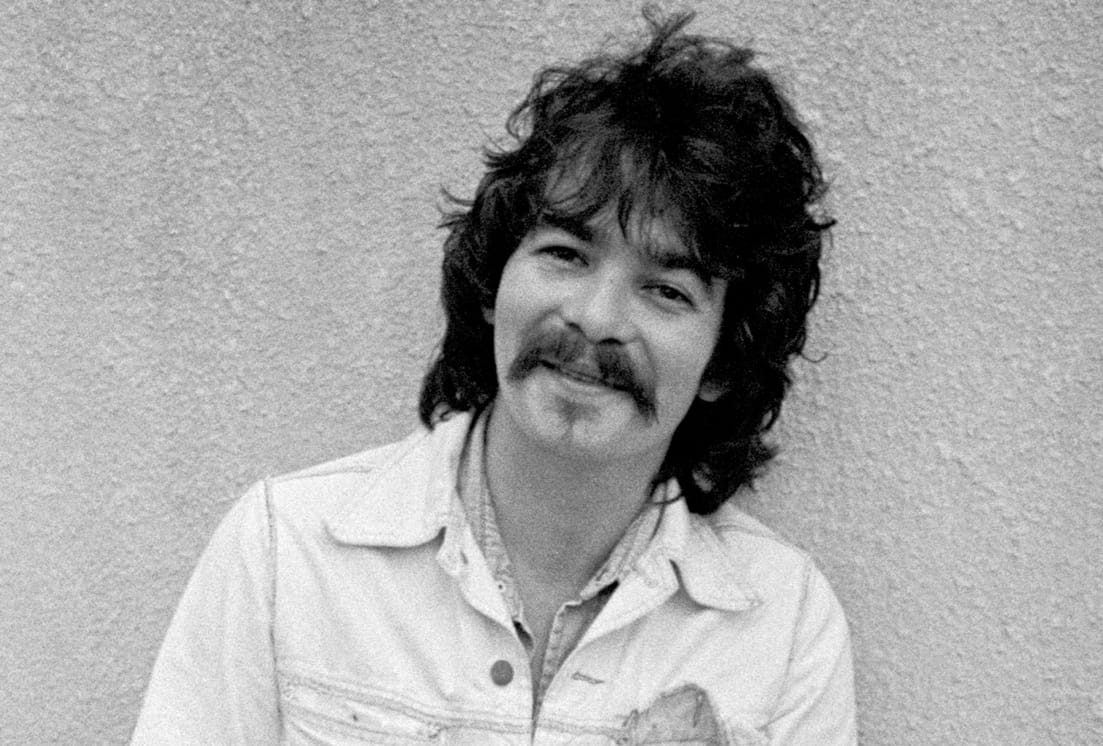
3. Al Green, Al Green Gets Next To You
"...where the elegant funk Al Green and company brought to the ‘70s truly roars forth."
Anthony Cougar Miccio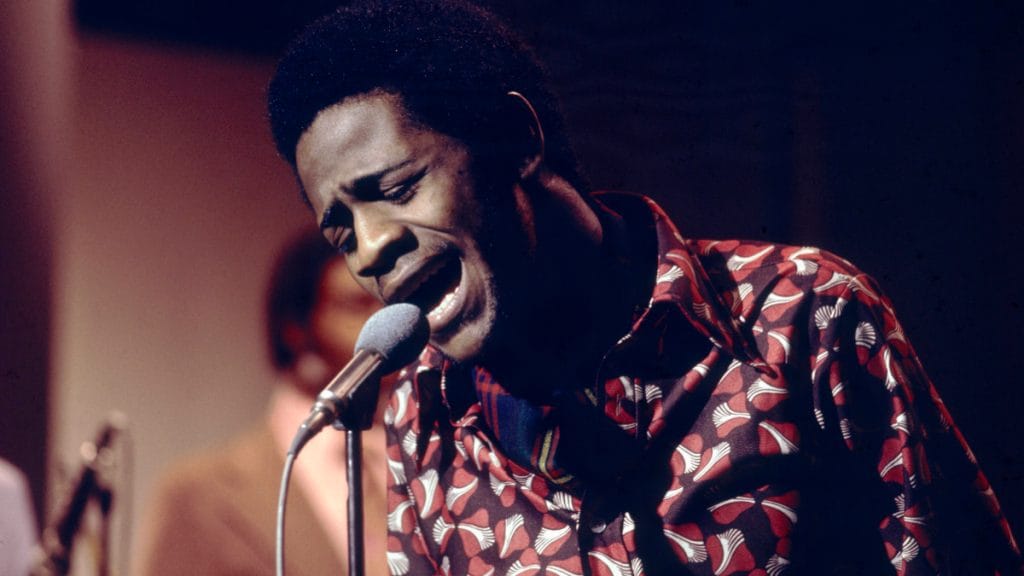
4. Joni Mitchell, Blue
"...Blue demolishes the annoyances of Canyon by centering feeling, both musically and lyrically. All questions of egoism are left in the dust, not to mention comparisons to her male peers and paramours."
Anthony Cougar Miccio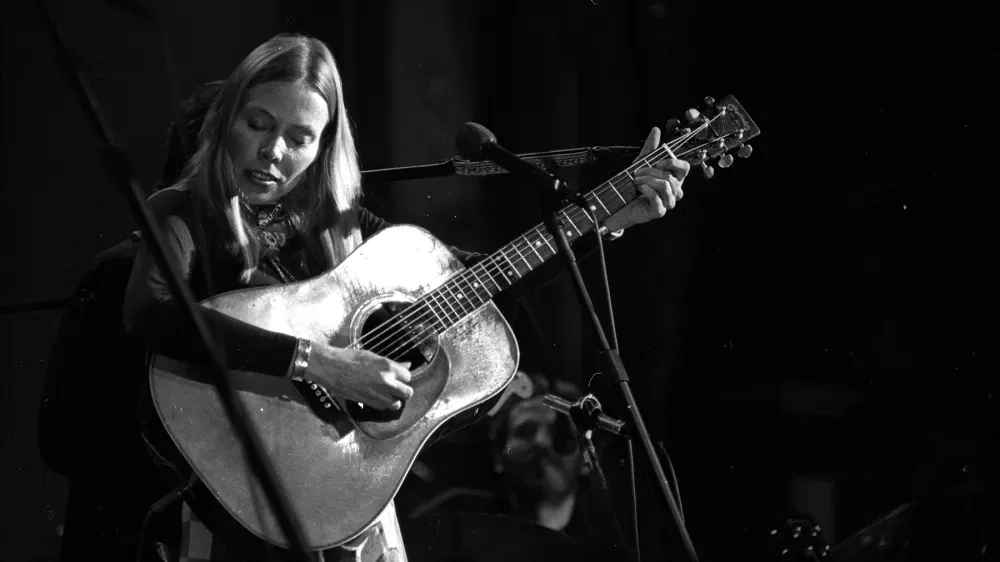
5. Led Zeppelin, Led Zeppelin IV
I used to consider this the band's godhead, but I find Robert Plant more annoying than usual on “Black Dog” (I can’t tell why he’s so snide about ladies) and “Four Sticks” (I can’t tell why anybody’s doing anything). Still, you probably couldn’t find a better six songs on a Zep album than the other six here. The preening ruckus of “Rock And Roll” is exactly that, the mythos 'n' mandolin of “The Battle Of Evermore” seems like it’s anything but, except both songs make Plant hump the air. “Stairway To Heaven” combines the modes and explains why bands attempt the power ballad after. “Misty Mountain Hop” is wickedly excited about that horny hippie life, “Going To California” the bittersweet prequel. Then the three musicians Voltron into a supernatural steamboat (irl, tape delay was involved), and Plant rides them up to Chicago or down to hell, taunting fate with his harmonica and pretty sure he’ll get laid at either destination. History has proven him right, and IV is where older hippies, the ones who sensed Tolkien would someday lead to action franchises, gave up trying to cockblock.
Sly & The Family Stone, "Family Affair"
6. Sly & The Family Stone, There’s A Riot Goin’ On
A totemic response to the bad vibes surrounding Sly and emanating from society, but you can read a book or watch a documentary about all that. What really makes this stand out from the glorious music that preceded it is Sly initially recording the songs alone, then using the Family Stone as seasoning in overdubs. It’s not unlike the swampy magic those other Stones would achieve on Exile On Mainstreet a year later, but even witchier, as the only opinion that mattered was Sly’s. The most heartbreaking song, “Family Affair,” was also the biggest hit, suggesting how many identified with its muttered anecdotes about failing sons and husbands. Surrounding it is a surreal storm of slowly disintegrating soul, brain-breaking in its disjointed allure, especially if you don’t know about its patchwork production.
Tom T. Hall, "The Year Clayton Delaney Died"
7. Tom T. Hall, In Search Of A Song
While I’m ignorant or agnostic about most country music from this era, Tom T. Hall is a big exception. Though his novelty hits could be as absurd as Jerry Reed’s or as schmaltzy as Mac Davis’, his best LPs promote Hall as a storytelling singer-songwriter. Not as acidic as Wainwright, Newman or even Prine, but with an arch wit suggesting how humanists get by in more conservative communities, deftly threading the needle between a common morality and a necessary cynicism. Though he’d been knocking out classics like “Salute To A Switchblade” and “A Week In A Country Jail,” In Search Of A Song, his fifth album in three years, was the first full-length to succeed as more than hits-and-filler.
After mourning his creative mentor on his second #1 country hit, and celebrating a farmer who truly lives to work, Hall finds inspiration on the road. After all, there’s historical tours to take before shows, ladies without last names afterwards, big cities getting bigger, small towns getting smaller, all providing stories to admire and truths to accept. Each side trails off into the saccharine and less surefire, and there’s later albums I like even more. But In Search Of A Song is the one that established his persona, one not unlike a local columnist praised for his laughs and loved for his conscience.
The Kinks, "Muswell Hillbilly"
8. The Kinks, Muswell Hillbillies
Though well versed in the Kinks’ glory days on Pye Records by college, I never bothered to hear this first album not on Pye until a couple years ago. Exceptionally thoughtful about nostalgia circa Village Green Preservation Society, leader Ray Davies (only in his mid-20s!) was already moaning “we’ve got to get out of this world somehow” by 1970. Nothing I heard from “Come Dancing” on (including an excruciating solo album I reviewed in the ‘00s) suggested he’d found a reason to exist beyond griping in the years since. But, after marveling at the Pye Anthology (with even more great outtakes than the ‘90s reissues!) and hungry for more good Kinks, I finally checked out Hillbillies and…it’s lovely! Relaxed in their five piece mode, but still driven by Mick Avory’s drumming, the guitars groove and keys tickle in gorgeous, unassuming good cheer, Ray’s smug nattering about how everything sucks rarely pulling focus. I should listen to the 1972 album someday soon…ish.
Loudon Wainwright III, "Motel Blues"
9. Loudon Wainwright, Album II
Less overwrought than the debut, but not yet up for “Dead Skunk” chuckles or broadened by parenthood ( “Be Careful, There’s a Baby In The House” sees it coming, though), Album II is Wainwright’s best Angry Young Man album, his voice thin and bitter over ragged acoustic chords. “Motel Blues” and “Nice Jewish Girls” aren’t using comedy to get ass, so much as letting you laugh while he desperately pleads for it. “I rarely make love, I mostly get laid” he says on a self-loathing medley that includes “Suicide Song.” “Make yourself a master, but know that you’re a slave” he coos to the fellow singer doing better than him. “The good old days are good and gone now,” he tells the friend he’s sick of. But then future ex-wife Kate McGarrigle joins him on an old cowboy song, and he admits winter passes. For a while.
Bill Withers, "Ain't No Sunshine"
10. Bill Withers, Just As I Am
A shy stutterer turned Navy man, self-possessed and proud enough that he’d rather get a real job than let you fuck with his art (that’s why he’s holding a lunchbox on the cover), Withers was already in his thirties when he made this recording debut. The opening “Harlem” is as sincere and cutting a tribute as Randy Newman’s “I Love LA,” delivered with a thump and holler that brings back to R&B what John Fogerty took. “Ain’t No Sunshine” somehow wallows in romantic ache within two minutes, “Grandma’s Hands” somehow paying deep tribute to maternal love just as quickly. The valentines and supper-club covers that follow that opening trio are hit and miss. But the album ends strong with “Moanin’ and Groanin’” and “Better Off Dead,” erotic guitar-funk respectively capturing him at his most ecstatic and agonized, hinting at the breakthroughs to come.
And now, some Xgau-esque honorable mentions, in order of descending enthusiasm!
Van Morrison, "Wild Night"
Van Morrison, Tupelo Honey
Hornier than his previous album, and better for it (“Tupelo Honey,” “Wild Night”)
Jerry Butler, The Sagittarius Movement
Veteran soul man commits to zen with an ironic intensity both earthly and cosmic (“Ain’t Understanding Mellow,” “Simple Country Girl”)
Pink Floyd, Meddle
A surprisingly casual, collaborative high point, especially if you start with “Fearless” (“Fearless,” “Echoes”)
Yes, The Yes Album
I won’t pretend they’re cool - and I’m mostly tolerating the “high alto-tenor” - but these multi-part maniacs could be a whole lot of fun (“Yours Is No Disgrace,” “Starship Trooper”)
Alice Coltrane, Universal Consciousness
Orchestral free jazz sitar harmonium extravaganza (“Oh Allah,” “Sita Ram”)
Alice Coltrane, "Oh Allah"
Cluster, Cluster 71
Unresolved sci-fi synth suspense for its own sake (“21:32”)
Nilsson, Nilsson Schmillson
Thank Richard Perry for Harry’s most ingratiating album, with big, shameless ballads, and the fun rarely at our expense (“Gotta Get Up,” “Jump Into The Fire”)
Crazy Horse, Crazy Horse
Danny Whitten was the best second banana Neil Young’s ever had, as proven by the only Neil Young posse album that doesn’t need Neil (“I Don’t Want To Talk About It,” “Look At All The Things”)
The Osmonds, Phase III
Crazy Horses has their heaviest hits, and The Plan has The Concept, but Phase III is their smoothest display of ‘70s showbiz swagger - more Donny, too! (“Yo-Yo,” “My Drum”)
Chase, Chase
Aptly named trumpeter Bill Chase decides Chicago and Three Dog Night don’t have enough trumpets, makes ‘70s action sequence gold (“Get It On,” “Handbags And Gladrags”)
Interrupting the honorable mentions...my favorite compilation of 1971!
A radio ad. Imagine.
Nilsson, Aerial Pandemonium Ballet
When RCA Victor suggested reissuing his first two albums between The Point! and Schmilsson, Nilsson - already a pioneer of singer-songwriter studio whimsy - decided to remix and re-order the tracks instead. I haven’t bothered to listen closely to how the ’71 versions of “Good Old Desk,” “One” or “Without Her” differ from the late ‘60s takes, but I find all three albums delightful when they’re on. It’s arguably the first remix album, with the irony that this was even less collaborative a venture than the original albums (those co-produced by Rick Jarrard).
Back to our honorable mentions!
The Undisputed Truth, "Smiling Faces Sometimes"
The Undisputed Truth, The Undisputed Truth
In essence, Temptations outtakes and alternate arrangements sung by Motown backing vocalists - heaven for addicts of producer Norman Whitfield’s “psychedelic soul” (“Smiling Faces Sometimes,” “Since I’ve Lost You”)
David Bowie, Hunky Dory
If you switch “Eight Line Poem” with the sass-classic “Queen Bitch,” the A side would be a definitive portrait of druggy, schizosexual chaos, Bowie giddy about parenthood when not positing that gays are the ubermenschen. You could also never play the B again (“Life On Mars?,” “Queen Bitch”)
Sandy Denny, The Northstar Grassman And The Ravens
The singer-songwriter’s solo debut ironically works more as a Fairport Convention reunion, Richard Thompson casually ripping solos in front of her band Fotheringay (“The Sea Captain,” “Down In The Flood”)
Bonnie Raitt, Bonnie Raitt
Raitt already sounds like herself at 21, which is awkward to think about when she follows a 5-year-old Stephen Stills song with a 45-year-old Sippie Wallace blues called “Mighty Tight Woman,” selling both (“Mighty Tight Woman,” “Any Day Woman”)
Miles Davis, Live-Evil
Everything over five minutes is a wild display of what his band could do. Except Side 4, where unfortunately, a poet tells us instead (“Sivad,” “What I Say”)
Miles Davis, "Funky Tonk" (excerpt)
Mott The Hoople, Brain Capers
Bombastic Dylan-rock, like Before The Flood before its time, and doubly odd since it’s not live (“Death May Be Your Santa Claus,” “The Journey”)
Leonard Cohen, Songs Of Love And Hate
His most bitterly romantic album, right from the cover. Probably helps if you’re bitter, too (“Dress Rehearsal Rag,” “Avalanche”)
The Mahavishnu Orchestra, The Inner Mountain Flame
Prog-jazz combo rocks harder than most prog-rock, the lack of vocalist a big plus (“The Noonward Race," "Awakening")
Black Sabbath, Master Of Reality
Their sanest album, proselytizing for God, pot and fingerpicking exercises (“Children Of The Grave,” “Into The Void”)
Miles Davis, Jack Johnson
Too much cymbal on the A, but - with its Sonny Sharrock and In A Silent Way cameos - the collage on the B gets pretty psychedelic (“Yesternow”)
If all the Osmonds you've seen is Crazy Horses or later...flip back a chapter.
Surprised to see this album and not that album? Feel free to reach out at anthonyisright at gmail dot com, and - probably in a Take Dump post - I'll reveal which curious exclusions I haven't heard, or just think are OK. One spoiler is here.