Joni Mitchell, pt. 1: Anthony's Album Guide
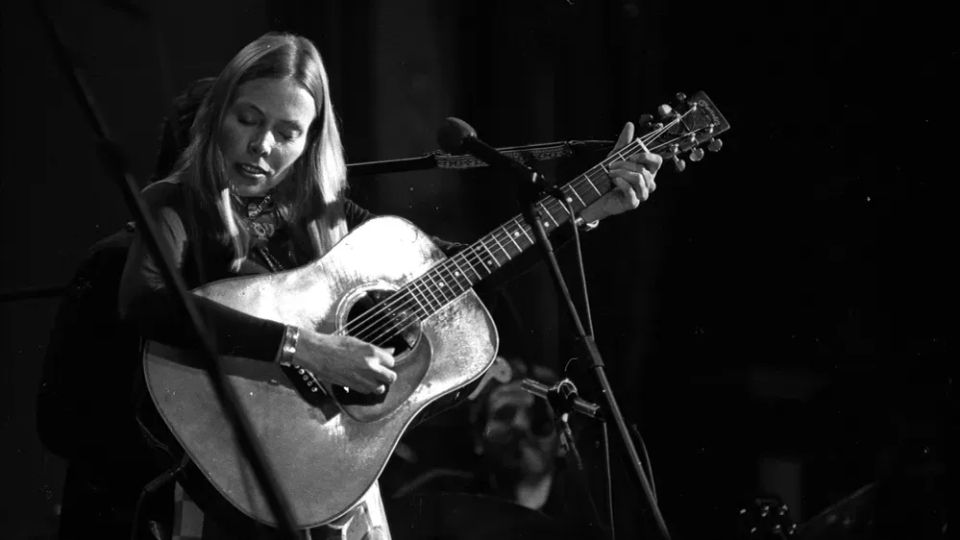
GLIB BOY ALERT: As confessed in my Sleater-Kinney album guide, I am a guy. And while this guy adored that pinnacle of feminist rock in his late teens, he found Joni Mitchell excruciating until his late 20s. Really getting down with Mitchell's music took almost another decade. So if she's long been your artistic ideal - or if you’re an old punk who thinks her soprano is a needle in your ear - you don’t have to humor this attempted critical appreciation. I’ve probably failed you both. My handy dandy profoundly subjective numerical rating scheme is decoded here.
Song To A Seagull (1968) 8
Clouds (1969) 8
Ladies Of The Canyon (1970) 3
Blue (1971) 9
For The Roses (1972) 8
Court And Spark (1974) 8
Miles Of Aisles (1974) 6
The Hissing Of Summer Lawns (1975) 8
Hejira (1976) 9
Don Juan’s Reckless Daughter (1977) 5
Joni Mitchell isn’t an easy artist to appreciate if you’re any kind of rock dude. She blazed an idiosyncratic, influential path between folk and jazz, you say? While carving a lyrical space for female identity and agency in the predominantly male LA singer-songwriter scene? A scene that inspired many of her songs? Well, please, let me turn off Fun House immediately! I’d love to spend time with this woman who was too smart for Graham Nash and James Taylor, but couldn’t stop thinking about them. Are those woodwinds? Fantastic! I’m going to set my Ramones albums on fire. I’ve seen the light.
Sorry, I still find her more distracting and embarrassing here than the digitally removed cocaine.
Another problem is how Mitchell is introduced to men of a certain lack of taste. Though she had a chart presence in the ‘70s, radio has mostly ignored her since beyond “Big Yellow Taxi” covers. So it’s been left to moms, sisters, or crushes to try and subvert a leather-prone paradigm. Consider that, in Martin Scorsese’s The Last Waltz, Mitchell is first seen behind a curtain, turning Neil Young’s “Helpless” into a cornball call-and-response. She then steps out to play the rambling non-hit “Coyote,” the Band respectfully galumphing to keep up. In Scorsese’s After Hours, after Griffin Dunne cries that he’s seen a dead body, Teri Garr politely replaces the Monkees on her stereo with Mitchell. Now matter how Joni makes a little badass’s radar, he probably isn’t happy about it. If Steely Dan gargled Seth Rogen’s balls for being associated with smug boomer intelligentsia, imagine the uptick in irritation when delicate, feminine sensitivity is thrown into the mix.
Always eager to broaden my appreciation of things (if quick to confirm when I can’t), I got over my knee-jerk recoil from Mitchell around the same time I did with the Dan. Though both refuse to pretend they find power chords as exciting as bebopadoobeedoopdooetc, their perspective is just as cutting as any punk’s once you get on their wavelength. Lou Reed was nice enough to blow out eardrums while barking about chemicals, but he also wanted you to recognize the influence of jazz and literature on him as well. The godfather of “alternative” was a singer-songwriter inspired by Bob Dylan to innovate and express, popular decorum be damned. Just like Fagen, Simon, Cohen…and Mitchell. I merely had to get over my beef with the hype of self-evident genius, not to mention flute, falsetto and fusion, to see it.
Confession: I didn't realize Fairport Convention was covering Mitchell when they did this.
Mitchell (nee Anderson) bounced around Canada as a kid, mostly learning about painting in school, while voraciously teaching herself about music. Her early 20s were spent performing folk and jazz hits on the road up north, weathering an unexpected pregnancy (the child put up for adoption) before moving with husband Chuck Mitchell to the states in 1965. It was around that time she learned of alternate guitar tunings from Eric Andersen. The weakness of her polio-damaged left hand sparked the interest, but she quickly realized its potential to create more complicated, novel sounds, the breakthrough quickly inspiring a growing songbook of originals. She was single again in 1967, friend Tom Rush getting those new songs out to other artists, and new boyfriend David Crosby taking her to LA’s star machine.
Song To A Seagull has a familiar hippie-folkie beauty, not too different from what artists from Sandy Denny to Janis Ian were up to at the time. But producer Crosby gets credit for avoiding the soon-to-be standards already being covered by bigger folk stars, and choosing spartan arrangements that center the interplay between Mitchell’s voice and guitar. Unfortunately, Crosby also set up too many microphones, creating a tape hiss issue that’s required multiple remixes over the decades. Recorded after higher profile touring, the next year’s Clouds cloaks any sophomore slump with proven ringers like “Chelsea Morning” and “Both Sides, Now,” already interpreted by Dave Van Ronk, Judy Collins and Fairport Convention. The sound is rawer, and the songs more direct than those on the debut. One could almost take the clumsier instrumentation and slower tempos for regression, but, with harmony and a cappella experiments on B, the change was more about stripping away folk-pop artifice in the name of self-expression. For better or worse.
I saw this clip from 1970 on VH1 before I actually heard any of her songs. It didn't help.
Sometimes I think all my adolescent, passive-aggressive animosity for Mitchell has centered on Ladies Of The Canyon, which recalls the worst qualities of the legendary ladies in her wake. Look, it’s Tori Amos’ baroque self-amusement! There’s the vain piety of Taylor Swift! On Canyon, Joni plays the knowing new star stuck in her limo, cooing valentines to the handsome men who can’t commit, staring daggers at their possessive wives, resenting the commoners who can’t appreciate the busker as much as she does, and moaning out in vocalese when words can’t capture the poetry of it all. “The Priest” obtusely socks it to religion and “Big Yellow Taxi” cutely socks it to capitalism. Then we’re blessed with sodden twists of the already popular copyrights “Woodstock” and “The Circle Game." “If CSNY did this kind of thing, why couldn’t she?” say defenders. But I wish 3/4ths of CSNY hadn’t done it.
Mitchell took a vacation from the road just before the release of Canyon, woodshedding and enjoying yet more love affairs. Surprisingly, she returned with songs both hipper and more heartbreaking on Blue. Maybe it was the validation of Canyon’s success. Maybe it was the quiet time, or some truly wounding interpersonal chaos (ladies sure love cool J Taylor). But Blue’s arrangements are remarkably sly, and the valentines far more vulnerable (painfully so, once you learn “Little Green” is about the daughter she gave up for adoption a half-decade earlier, a fact not even publicized until the 1980s). Side A veers from the romantic intoxication of “All I Want” and “Carey” to the stoic regret of “Pretty Green” and “Blue,” establishing broad parameters for Mitchell’s increasingly jazzy vocals. Her style is so brisk it could be mistaken for “conversational,” until you try to tackle their lyrical density yourself. By Side B’s “River” and “A Case Of You,” she’s careening across the emotional spectrum mid-song. Blue demolishes the annoyances of Canyon by centering feeling, both musically and lyrically. All questions of egoism are left in the dust, not to mention comparisons to her male peers and paramours.
Why didn't VH1 play me this?
Even more confident after Blue’s tour, the music on For The Roses is almost as alluring, even if the words have turned back to judgmental scene reports. Tom Scott’s reeds are hard to miss, but other accompaniment requires close attention to notice over Mitchell’s transfixing vocal leaps and busy chords (increasingly performed on piano, rather than guitar). Though it was getting harder and harder for fans to learn these tricky numbers, the hit “You Turn Me On, I’m A Radio” lets them clap along as she acrobatically flatters and negs some self-involved stud. “Woman Of Heart And Mind” might be the definitive song of this period, Juliet almost 30 and worried Romeo’s out of surprises. You’ll either appreciate the bittersweet portrait of a knowingly fragile love, or cry “dump the fucker! And whoever’s playing bongos, too!”
Joni returned in early 1974, hiding out writing & recording with drummer boyfriend John Guerin for most of the year previous. The leap from tender folk to panoramic jazz-rock is complete on Court & Spark, with hot guitar licks from guest musicians and character portraits. Sometimes I think it’s her most overrated album, at least by me. The wry, flute-festooned tribute to then-label head David Geffen can be buried with him, and I find “Help Me” - her sole Top 10 hit - almost as annoying. But, Scott’s occasionally grating fanfare aside, the instrumentation is often bewitchingly triumphant. The B Side is particularly playful and unpredictable, even before Cheech & Chong show up on a ‘50s jazz cover. Mitchell is even more the unabashed star on Miles Of Aisles, a double live victory lap released the following November. I wish the slower, solo material preceded the showier performances with LA Express, Live Rust style, instead of dragging down Aisles’ middle. But hardcore fans won’t mind at all.
Honestly, I prefer Tom Scott doing this, rather than multi-tracking woodwinds.
For younger audiences - like, people under 50 - it can be understandably hard to get why critics might have been cranky about The Hissing Of Summer Lawns. Today, following your pop breakthrough with jazzy poetry over soundscapes is what we want. It’s what thrilled Prince and inspired Radiohead (compare “15 Step” to “The Jungle Line” sometime), those guys now influences themselves. The absence of Tom Scott’s tooting is reason enough for want me to praise it over Court & Spark in theory, but Lawns gradually turns from arresting to merely elegant, and the subject matter - people are so superficial, yo - is aggressively familiar.
Some say the same curse afflicts Hejira, while others consider it a career highlight. Pitchfork even cheated a bit, letting Jenn Pelly write a 10.0 Sunday Review - suggesting they hadn’t already rated it - though Jessica Hopper already called it a “real grown woman album,” next to an 8.0, a decade earlier. I’m in the latter camp, as Hejira feels like the overdue acknowledgment that life providing familiar subject matter is a you problem. “Coyote,” barely connecting in The Last Waltz, becomes a rollicking opener thanks to guitarist Larry Carlton, percussionist Bobbye Hall and an overdubbed Jaco Pastorius on fretless bass.
A way better rendition of "Coyote" with some dudes than that Last Waltz one.
Throughout Hejira, Mitchell plays with country yearning in her voice and road iconography in the lyrics, while the musicians (including the LA Express rhythm section of Max Bennett & Guerin), guided by producers Mitchell & Henry Lewy, invent gorgeous, ruminative backdrops that foretell both the future of fusion and ‘80s Americana. It can be hard to believe her wanderlust was inspired in part by a bummer sojourn with the Rolling Thunder Revue, or that Neil Young contributes the harmonica on “Furry Sings The Blues,” as Hejira feels light years away from her fellow Last Waltzers, both in sound and sensibility. Like Bill Withers’ still-underrated +’Justments, Hejira earns that “grown” adjective through an atypically reflective take on romance, where heartbreak and alienation stops feeling like an injustice, and more like a symptom of something bigger. Something you either need to get over, or learn to live with.
Or maybe you just go crazy. With Hejira initially earning shrugs and Mitchell excited to leave the cowboy philosophers of Asylum Records behind, she decided to let it all hang out with her first studio double. Side 1 of Don Juan’s Reckless Daughter suggests the heroine of Hejira growing frantic with frustration. Mitchell almost recalls avowed fan Chrissie Hynde in her edginess, even clucking like a chicken on “Talk To Me.” But “Paprika Plains” - the whole of Side 2, and three minutes longer than the side that precedes it - is an attempt at piano improvisation and orchestral overdub recommended if you thought Neil Young & Jack Nitzsche didn’t go far enough on Harvest. Side 3 follows almost seven minutes of drum circle with “Dreamland,” a poetic overview of race relations that’s the missing link between “Brown Sugar” and Graceland. “Tar baby and the Great White Wonder/ talking over a glass of rum/ burning on the inside/ with the knowledge of things to come.” Ok. Side 4 of Daughter is basically More Hejira, the title track literally more “Coyote.” Lest you suggest she was crazy like a fox on this one, she helpfully appears on the cover (not rescinded until 2024!) as a pimp in blackface, a character named “Art Noveau” she considered an internal muse.
Warning: Art shows up around 4:30 here. We’ll never be ready.
I do plan to investigate Mitchell’s work from 1978’s Mingus onward, but - considering how long it took me to make sense of her ‘60s & ’70s discography - I’m no more in a rush to pick through her awkward, later adventures than I am Bob Dylan’s. I know fans really dig the smoky re-recordings and renditions she put out on 2000’s Both Sides Now and 2002’s Travelogue, which I’ll probably listen to before the “political” ‘80s stuff she made for Geffen with fans like Thomas Dolby. And obviously, I’m glad she’s recovered from that aneurysm a decade ago, belatedly enjoying archival releases and live celebrations since. Look back at what I said about Dylan’s last four decades if this doesn’t seem enthusiastic enough an adios. It’s all relative.
Even earlier proof than Herbie Hancock's River that true heads are down with Joni.
Hejira, Blue and Court And Spark are at 27, 138 and 315 on my Top 400 Albums Of All Time. If you want to tell me which '80s Bob or Joni album means the most to you, now's not the time. But if you have any questions or suggestions that don't involve praising the later works of someone who's gonna get a statue when they die and already earned some 9s from me, the place to send them is anthonyisright gmail dot com.