Bauhaus: Anthony's Album Guide
GLIB XENNIAL CONTENT WARNING: I wasn't there, and I don't recall wearing make-up since I was the Joker for Halloween circa "So Alive." While I hope my enthusiasm is clear, I understand if you don't think I really get it. My handy dandy profoundly subjective numerical rating scheme is explained here.
In The Flat Field (1980) 8
Mask (1981) 9
The Sky’s Gone Out (1982) 6
Press Eject And Give Me The Tape (1982) 6
Burning From The Inside (1983) 5
1979-1983 (1985) 6
Swing The Heartache: The BBC Sessions (1989) 6
Crackle (1998) 6
Go Away White (2008) 6
Singles (2013) 8
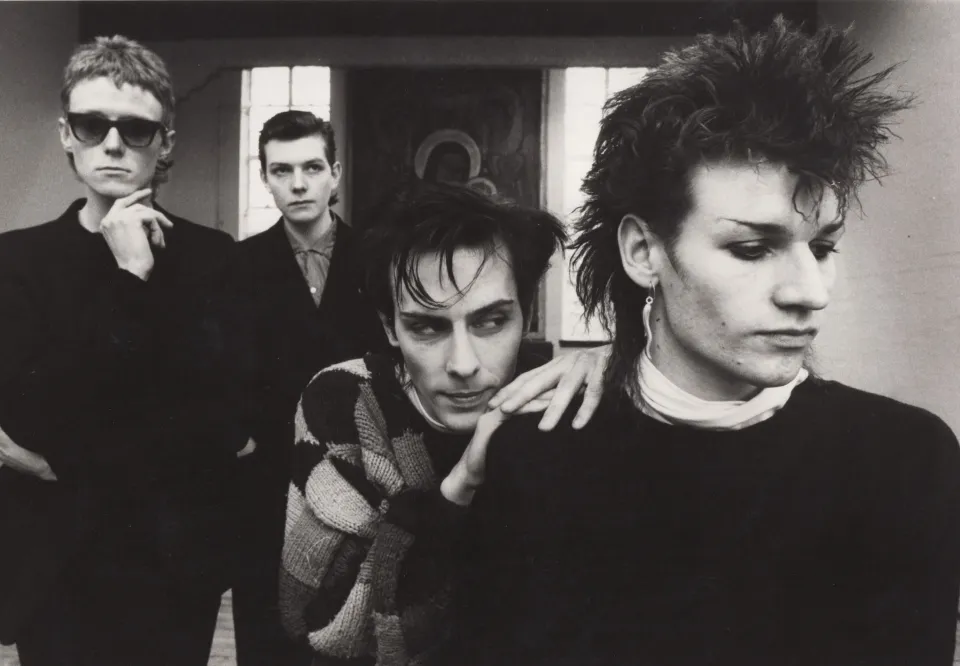
Goth, as you likely know, is the modern rock subculture where every day is Halloween. And Bauhaus was the first goth band. Not that goth was invented by this quartet from Northampton, England in 1979, any more than heavy metal was invented by Black Sabbath, a quartet from nearby Birmingham, a decade earlier. Ominous bombast and bad vibes had a place in music centuries before the fashion accessories and effects pedals that made new rock genres possible. Consider Mahler, and monks. Plenty of bands were dressing like creeps and screaming about demons over minor chords at the same time as the acts in question. “The Monster Mash” was almost twenty when “Bela Lugosi’s Dead” came out! What Bauhaus and Black Sabbath did was deliver a streamlined, unapologetic version of a budding aesthetic. If haters were asked to explain what they meant by “goth” or “heavy metal,” they could point to the respective band and say “this bullshit.”
"Bela Lugosi's Dead" was twenty when this sketch aired. The sketch is now twenty-six.
One can argue Led Zeppelin was so much more than apocalyptic mysticism from neanderthals. Similarly, Joy Division was so much more than cartoon horror from David Bowie clones. But Sabbath and Bauhaus demanded fans not only accept the qualities sparking knee-jerk dismissal, but embrace and find beauty in them. This isn’t to say they weren’t a cut above those milking the market in their wake. It's that their virtues were impossible to divorce from the satisfactions of the scenes they unintentionally defined. Heavy metal has to ka-boom just so, and no one can deny that Sabbath ka-boomed. Goth has to be a sexy, spooky, post-punk party, and nobody threw one like Bauhaus.
The band began in late ‘78 when guitarist and glam-enthusiast Daniel Ash finally convinced his arty pal Peter Murphy to pick up a microphone. The latter’s gaunt magnetism already suggested rock stardom, the way tall people get asked if they play basketball. Kevin Haskins soon joined on drums, but it took a while for Ash to admit Kevin’s brother David J should play bass, as J had a lot of opinions for a bass player. It was J that thought of jacking the name, logo and typeface from a German art movement, a far classier way to suggest their primary influences than calling themselves Iggy’s Idiots or the Berlin Trilogy.
Bauhaus covered "Sister Midnight" when I saw them in 2019. They were right to do it.
Blessed with the accidental genius of youth, the gang’s taste for the Teutonic was matched with a love for the soundscapes of Jamaican dub. Many of their songs were built off improvisatory jams and fooling with echo effects. The brothers Haskins would get a cavernous, cold groove going. Ash would riff, scrape and squeal above it, until Murphy - once too shy to join Ash at art school, now regularly shirtless on stage - unleashed the beast. Their shtick was immediately too cool for the local cover band circuit, and in a few weeks they were ready to record a demo.
A conversation along the lines of “you know who’s sexy? Dracula!” inspired a midnight creep through the crypt that was not only recorded in one take, but somehow doesn’t get boring over nine minutes. Most companies balked at the length, but the singles label Small Wonder raced “Bela Lugosi’s Dead” to press, the indie chart responding excitedly for two straight years. Though Bauhaus were hip enough to swear the song was tongue-in-cheek (and I do giggle when I hear Murphy croak “the count!”), they also cared more about leaving Northampton than undermining a selling point. The following singles for 4AD, “Dark Entries” (more violent) and “Terror Couple Kill Colonel” (more perverse), basically shout “you wanted the chills, you got the chills!” The covers for these 7-inches were striking lifts of early 20th century art, but could have gone the Cheap Trick route: Ash and Murphy as salon-stylish ghouls on the front, the Haskins’ relatively modest beatnik fashion on the back.
"Dark Entries"! "Dark Entries"!
In The Flat Field, coming just over a year after “Bela,” blurry photo of a nude horn-tooter on the cover, leans hard into this transgressive rep. “I dare you to be proud/ to dare to shout out loud!” hollers Murphy on the opener “Double Dare,” the song gradually collapsing into lurching, nightmarish cacophony before Swans were even cygnets. “I do get bored!” Murphy wails on the title track, Ash transforming from a mosquito to a spark-shooting buzzsaw and back again over the Haskins’ rumble. Plenty of portentous nonsense follows, but so does the chipper Roxy Madness of “Dive,” the shrill nattering under “Small Talk Stinks,” and “St. Vitus Dance,” where Ash’s lead is so distorted it sounds like a mouth harp. Alice Cooper would have paid good money for the growling grandeur of “Nerves,” which cops from Judas Priest as much as Pere Ubu. Monochromatic? Sure. But anyone disappointed that the Spiders From Mars didn’t actually sound like alien arachnids now had the evil, otherworldly art-rock of their dreams. And Field topped the indie charts.
Less than a month later, the fans were thrown a rip-roaring, off-hand cover of T Rex’s “Telegram Sam.” Its B-side, “Crowds,” was a rather scabrous piano ballad about fame for a group not even two years into the game (“you worthless bitch/ you fickle shit/ you will spit on me/ you will make me spit”). Murphy may have simply been playing the part, and joining “Crowds” on the 12-inch was a cover of John Cale’s “Rosegarden Funeral Of Sores” that’s delicious showbiz compared to the more unnerving original. Then again, the band had already toured America and Europe, forced to move from 4AD to Beggars Banquet cuz more and more kids were clamoring for the scary stuff.
What TV rating would the "Mask" video get? TV-14? MA? There is that loogie.
March 1981’s “Kick In The Eye” flaunted a bottom so funky Oingo Boingo stole it for the Weird Science theme. Bauhaus’ second album, Mask, arrived in October, preceded by Siouxsie & The Banshees' Juju and The Cure’s Faith. It was truly a banner year for dry ice foggers, but Mask wins best in show by bouncing from Hammer-worthy tales of terror (“Hollow Hills,” “The Man With X-Ray Eyes”) to zombie jamborees (“In Fear Of Fear,” “Dancing”) like it truly ain’t no thing. Adventurously self-produced by these proud Eno fans (though Cure collaborator Mike Hedges was among the experienced engineers), Mask reaches a surreal apex on the title track. It’s a rare rock “sound collage” that isn’t filler, the sudden arrival of a guitar lick suggesting the transcendent escapism horror can provide. The “Mask” video is a must-see, shot in an abandoned factory back home, and still one rattling casserole of midnight movie iconography decades later. Aired once in the UK, and untouched by MTV, I can only imagine what a thrill it was to find before YouTube.
Having delivered a sophomore album even more definitive than the debut, Bauhaus wasn’t sure what to do next. The single “Spirit,” was a grand, lovely tribute to the fifth member of band (…you), but required over a week spent with Hugh Jones, who had just produced “I Melt With You” for the relative unknowns in Modern English and understandably felt this should be a bigger deal (it wasn’t). Disinterested in such fussiness, the boys went back to self-producing on The Sky’s Gone Out, re-recording (but not improving) “Spirit” and confusing the engineers with rehashes and sub-“Mask” experiments like “Exquisite Corpse” and the three-part “The Three Shadows.” It’s still kind of a trip, but the most popular song is the ballad reminiscing about the good old days (“Bela” not even four years old). The most exciting song is the opening cover of pre-ambient Eno’s “Third Uncle.” A cover of Bowie’s “Ziggy Stardust,” played straight as a wink to their haters, was released alongside Sky and became a Top 20 hit. Regular UK chart, not indie. Though they enjoyed the attention, it didn’t resolve any artistic differences.
Anyone balking at the alleged novelty of "new wave" in 1982 must have smirked hard at this.
“Lagartija Nick,” a solid, saxtastic follow-up to “Ziggy,” failed to even go Top 40, possibly because people weren’t sure how to pronounce “Lagartija.” At the same time, Murphy was lip-syncing “Bela Lugosi’s Dead” in the opening scene of The Hunger (a movie starring David Bowie as a vampire with two girlfriends, apt) and featured in an ad for Maxell cassettes even more iconic than the stuff Bauhaus lifted from art books. Despite - or because of - this extracurricular attention, the other three wouldn't let Murphy’s bout with pneumonia keep them from recording most of Burning From The Inside without him. “Antonin Artaud” does its theatrical honoree proud, and the title track is a death-rattle bookend with “Bela,” Murphy repeatedly belching “any!…MORE!” over a decrepit disco riff for the last three of its nine minutes. The rest of the album is a meh single (the polished doom-dub of “She’s In Parties”) and a lot of esoteric filler by default from the future Love & Rockets.
“Parties” reached the UK Top 30, but after a long promo tour, Bauhaus called it quits just before Inside’s release. Spin-offs like Tones On Tail (Ash, Haskins & a roadie), Dali’s Car (Murphy & fretless bass wunderkind Mick Karn) and Love & Rockets (Ash, J & Haskins sticking together after Murphy bailed on a reunion in 1985), not to mention Murphy, Ash and J’s solo work, earned the original band godfather status, labels issuing plenty of Bauhaus compilations and archival live releases over the decades. None of it sucks, and Crackle is a great compilation if you can’t fathom owning more than an hour of these guys. But it’s the relatively recent Singles that I slot after Flat Field and Mask on the shelf, featuring all the aforementioned As & the most worthwhile Bs, including personal favorites like the frantic cowbell frenzy of “Watch That Grandad Go” and a weird version of “Spirit In The Sky” I’ve somehow yet to hear in a movie trailer. I could do without the “Tomb Raider mix” of “Bela,” but - as long as I can stream the original - I’ll live.
I saw a bunch of antique cars slowly roll through a suburban Colorado 4th of July parade to this in 1989. And I'll never forget.
If you didn’t appreciate my suggestion that the Ash & J vocals on Inside are “filler by default,” you really won’t like my belief that each splinter project is one to three quarters as juicy as Bauhaus, depending how many quarters of Bauhaus are involved. Love & Rockets got a worldwide smash out of the T. Rex tribute “So Alive” in 1989, Murphy having his biggest hit a year later with “Cuts You Up,” a college-rock make-out classic eating the lunch Bowie left behind while playing with Tin Machine. Sorted!: The Best Of Love & Rockets grabs their most winning moments, leading with the cheekily visionary “Kundalini Express.” Every so often I double-check if I missed a worthwhile full-length from one of these guys over the last forty or so years. I’m not saying it doesn’t exist, but I’ve yet to find it.
Bauhaus first reunited with a tour in 1998, later going viral with a legendary 2005 Coachella gig where Murphy sang all of “Bela” while hanging upside down (I dare you to try it for even a minute, assuming you have a spotter). That stint back together ended in 2008 with Go Away White. It’s nothing major, but certainly a happier finale than Burning From The Inside. Instead of trying to outdo their earlier anarchy, most of the cleanly produced album finds Murphy proudly warbling and barking over the groovalicious bubblegum his pals had been up to without him.
Coachella "Bela" '05. Coolest reunion performance ever.
With the band still earning eyerolls from critics in the ‘90s, every full-length getting a 4 out of 10 or less in the SPIN Alternative Record Guide, I didn’t find out until this century that their sepulchral flair made them no less enjoyable than Public Image Ltd, the Birthday Party, or any other post-punk combo with slightly less hairspray. I’m glad to say I caught another reunion gig myself in late 2019 (even spotted Lol Tolhurst on the floor!). Age and injury made Murphy less chaotic a stage presence, but no less dramatic: more poses in the stark lighting, fewer conniptions. The setlist was jam-packed, and while they weren’t above sound effects and sax (I had no idea Ash handled the horn until he went full The Lost Boys on stage), it was still mostly vocals-guitar-bass-drums like countless bands before and since, goth and not. I get why the night ended with “Ziggy Stardust,” but I wish they capped the encore with an original. It was Bauhaus’ mark on rock we were there to celebrate.
Bauhaus: a graveyard smash.
Mask is at 134 on My Top 400 Albums Of All Time. I'm telling you this because I've found people are more inclined to discuss and share reviews if there's a quantitative element at the top or bottom they can easily debate. Prove me right! If you need to tell me that the first goth album is Nico's The Marble Index, or make a less futile point, you can send it to anthonyisright at gmail dot com.