Aerosmith, pt. 2: Anthony's Album Guide
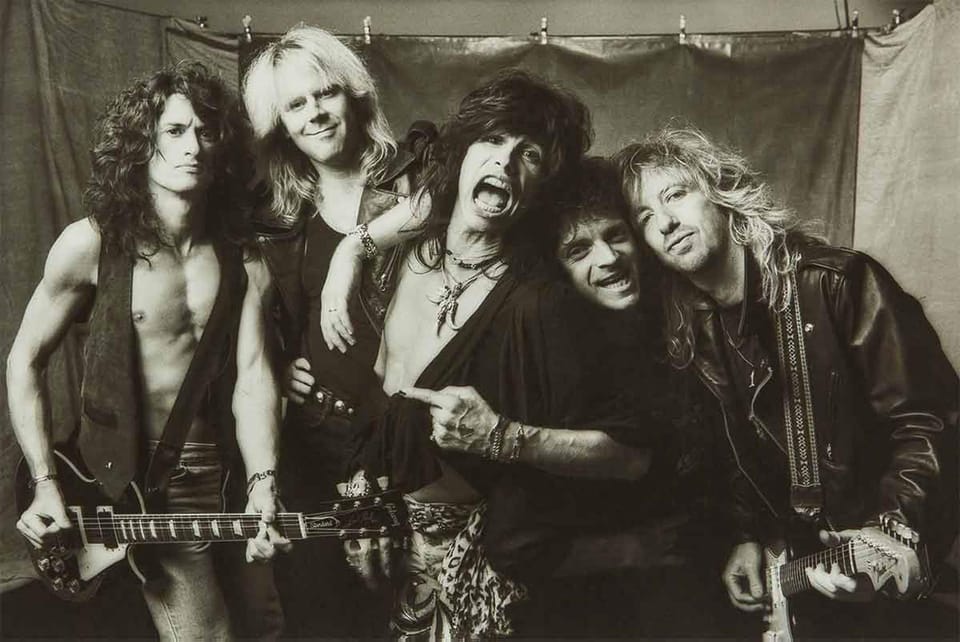
GLIB XENNIAL WARNING: Not only do my caveats about Steven Tyler’s backstage boogie in pt. 1 remain, this post covers when Aerosmith became “decrepit clowns making millions harmonizing about elevator sex.” Though I learned how cool Rocks was in college, and the de-evolution of Weezer has made me sympathetic to what an embarrassment commercial rock cockroaches can be for early adopters, I can’t pretend this wasn’t the Aerosmith I grew up on. If you still have cultural trauma from watching a scarf-swaddled crypt-keeper shriek at starlets every afternoon on MTV, I respect that, and suggest you ignore my modest affection for it. My super-subjective rating scale is explained here.
Done With Mirrors (1985) 5
Permanent Vacation (1987) 7
Pump (1989) 8
Get A Grip (1993) 6
Nine Lives (1997) 5
A Little South Of Sanity (1998) 4
When we left off, Aerosmith was running on chemical fumes, no original guitarists and no label support. But with the world not clamoring for more Joe Perry Project or Whitford/St. Holmes either, the prodigal riffsmiths returned for a reunion tour in 1984. Fans were jazzed, with Columbia impressed enough by the attention to claim rights on the related live recordings, Geffen giving the band a deal for new studio stuff.
Marty Callner didn't direct this one.
Though certainly more credible than the faceless, forced Rock In A Hard Place, I’m not sure why anyone would get off on Done With Mirrors today, except as a rebuke of what’s to come. The album is a “back to roots” move, in that it resembles an updated version of their 1973 debut: a relatively leaden, tentative effort from a group that might outshine Alice Cooper on a good night for them, or a bad night for Alice. Producer Ted Templeman was hot off Van Halen’s 1984, which might explain why drummer Joey Kramer is buried in ‘80s echo, and why it sounds like there’s only one guitarist despite Joe Perry and Brad Whitford both back on board. I file Mirrors with Too Tough To Die, Little Creatures and Dirty Work as proof the mid-'80s was a rough time to be a critic standing by '70s rockers. I was still in short-pants, admittedly, and can’t say for sure.
Coincidentally (or not, as producer Rick Rubin’s lightbulb might have come from by Chuck Eddy’s rap-referencing review of Done With Mirrors), a windfall arrived when Run-DMC invited Perry & Steven Tyler to join them on a scratch-happy version of “Walk This Way.” As MTV taught a young generation about “The Toxic Twins,” Aerosmith’s new manager Tim Collins got them into rehab, and pop-metal A&R guru John Kalodner convinced them to incorporate all the bells & whistles Done With Mirrors abjured, aided by Bon Jovi producer Bruce Fairbairn. The stars had aligned for a comeback far larger than the AOR touring circuit and the Village Voice.
Marty Callner directed this one.
Again, as I was still in short-pants, and can only imagine what it was like to see Aerosmith go from “Let The Music Do The Talking” to “Walk This Way” to “Dude (Looks Like A Lady).” A not-quite-wry tribute to hair metal androgyny, acquiring dubious connotations well before Mrs. Doubtfire, I give “Lady” a pass for the same reason I do the Kinks’ “Lola”: it’s super catchy, and the conclusion to all its whimsy over gender confusion is “love is love.” Or, in Aerosmith’s case, “fucking is fucking,” Tyler shrieking “do me! Do me! Do me!” in but the first climax, followed by a rollicking guitar solo, a second bridge, and a minute-plus coda (“Yyyyow! Yow, yow! Ya ya ya ya ya ya ya yow! Yow! Yow! Yow! Yow! Ya-ka-ka-ka-ka-ka-ka-ka-ka-kow!”). “Rag Doll” confirmed specious heterosexual activity also remained on the menu, complete with cavernous drum pocket, brass bombast, layers of slide guitar and another coda where Steven Tyler’s euphoric vocalese makes David Lee Roth look like Jackie Mason.
While both those songs made the Top 20 - last accomplished without Run-DMC in 1976 - the ballad “Angel” reached a new career peak, with or without Run-DMC, of #3. The synth-piano and symphonic wallop must have been too Bon Jovi for some old fans, even bassist Tom Hamilton cringing before he saw how many bikers loved it. Personally, I think it crushes Bon Jovi at their own game. Tyler swoons with more desperation and gratitude than that Jersey poodle ever could, despite also describing himself as “a dog without a bone.” Boosted by a well-treated mellotron, “Angel” makes a successful booty call sound like god’s grace raining upon thee, and who’s to say it’s not? The rest of Permanent Vacation maintains the concussive volume of the three hits, but only the title track, steel drums adding a surreal edge to the onslaught, holds as much interest. There’s also a brief Beatles obscurity, if that’s more your thing.
Marty Callner didn't direct this one. The guy who made Zodiac did.
As gauche as this Child/ Vallance/ Knight/ Fairbairn/ Kalodner/ Callner business felt to the once-sympathetic punks and hippies who appreciated the quintet’s sly smarts in the ‘70s, rock critics stuck between New Jersey on one side and Steel Wheels on the other were more prepared to acknowledge the band’s still-exceptional enthusiasm on Pump. Though I’ll argue that pagan trumpet at the end of “Love In An Elevator” puts the song’s skyscraper fantasies in conversation with Roxy Music’s “Virginia Plain,” I understand if you respond with vomit. After that obscene introductory single was “Janie’s Got A Gun,” fatherhood apparently causing Tyler to reckon with the dark side of “Young Lust” fantasies, asking fans to identify with a victim of sexual abuse.
Thanks to David Fincher’s grippingly cinematic video, you might forget that the song itself is a masterpiece of melodrama. After an enigmatic, ominous intro, Tyler careens between murderous contempt and consuming terror, with startling empathy for his heroine. Perry’s chaotic car chase of a guitar solo offers no relief. The unsettling arrangement, perversely built around a Hamilton hook not unlike “Sweet Emotion,” turns darkly happy at the end, implying the creep’s death is a relief, and that Aerosmith, ironically or not, is all for feminist retribution. The MTV hits are the highlights on Pump as they were on Vacation, “Elevator” and “Janie” soon joined in rotation by the heartbroken hysterics of “What It Takes” and the brass-boosted bubblegum of “The Other Side.” But success and/or sobriety restored confidence in their basic attack, the deep cuts regaining some of that Rocks kick. Though the Top 40 was notably full of fortysomethings in 1989, none did a better job than Aerosmith of seeming cybernetically enhanced, rather than coasting on reputation.
If only Marty Callner got to make clips for every '70s AOR hit.
Already exploiting this surprise comeback with live releases and compilations, Columbia re-signed Aerosmith in 1991 for eight figures, all the more impressive as they were only halfway through their Geffen contract. Between such financial stakes, and labelmates like Axl Rose and Kurt Cobain only some of the cultural competition, John Kalodner brought in every song doctor possible for Pump’s follow-up. Desmond Child and Jim Vallance were now joined by Lenny Kravitz, the non-Nuge members of Damn Yankees, Mark Hudson, and even Richard Supa, who’d written those late ‘70s ringers. Though MTV never stopped pushing these guys - don’t forget the “Dream On” and “Sweet Emotion” clips I mentioned in pt. 1 - you’d be forgiven if this sounds nothing like the dream of the ’90s.
Then again, Meat Loaf’s Bat Out Of Hell II: Back Into Hell went multi-platinum in 1993, and so did Aerosmith’s Get A Grip. A video full of high school horrors, starring Edward “Terminator 2” Furlong, helped “Livin’ On The Edge”s six thunderous minutes of zeitgeist-bait mesh with Pearl Jam better than Def Leppard’s “Let’s Get Rocked” had, and Grip opened not just with rap signifiers but a racing demand to “Eat The Rich.” The most important showbiz of all was supplied by three videos starring Alicia Silverstone as the pouty, impudent minx young Aerosmith fans should be glad to get blue-balls from, or hope to be. Those clips were so omnipresent that it took me decades to realize what a joyous sing-a-long “Cryin’” can be, the key change in its eye-bulging back half turning this MTV blues-rock from generic to definitive. “Crazy” is its own self-parody just two tracks later, though Liv Tyler, daddy’s oldest, helped Silverstone keep MTV from noticing. I’ll confess the VR Silverstone fantasy kept this frustrated teenager from grasping how cheesy “Amazing” was until the ‘00s.
With Aerosmith’s familiar, if state-of-the-art, ruckus up front (Joey Kramer gets VIP credit for “Fever” alone) and those big ballads at the end, the commercial ingenuity of Get A Grip is still audible today. But I’m spent by “Livin’ On The Edge,” and that’s just track 5 of 14. Still waiting between the three ballads heard too often, are hyper non-hits I’ll never be able to remember (even Joe gets to sing one!). Had they trimmed Grip to LP length (maybe put the Lenny Kravitz one on a soundtrack? And put the instrumental in a toilet?), the machinery would be undeniable. But with Viagra not yet approved by the FDA, I’m not sure how fans made it through the hour-plus.
What's amazing is how much Marty Callner got right about our technological future. Uncanny.
Blessed by all this wealth and Sonic Youth too, Geffen agreed to a compilation and a live album to be named later, letting Aerosmith begin that deal with Columbia. While nothing compared to what went down in the ‘70s, drama finally began to brew. The new/old label wasn’t happy with the material recorded by Glen Ballard (then the Jagged Little Pill guy, not yet the Return Of Saturn guy), those sessions already fraught due to Kramer’s battle with depression. Manager Tim Collins was loudly fired for suggesting only he could keep them from smack. John Kalodner - also moving to Columbia - monitored the re-recording with producer Kevin Shirley, fresh off Silverchair’s Frogstomp and the last Journey album with Steve Perry.
1997’s Nine Lives, the long-awaited outcome of that 1991 contract, could have been named Lose A Grip. The title track earns its cat sample, Tyler still able to spiritedly holler the obvious (“puss and booty”) next to the esoteric (“engine room to bombardier”) as the band whams away at light speed. Sadly, it’s immediately followed by Kalodner corn that never transcends its title (“Falling In Love Is So Hard On The Knees”), and a ballad that makes “Crazy” look like “Cryin’” (I liked the line “there’s been all kinds of shoes underneath your bed/ now I sleep on my futon” but he’s actually saying “with my boots on”). Though a more flattering track order might have helped, all that breaks the flop sweat is “Pink,” an atypically relaxed mid-tempo stroll through Steven’s erotic rhyming dictionary. Lives wound up their weakest seller since Mirrors.
Ironically, Michael Bay did not direct this clip. Francis Lawrence did.
Profit came a year later, as Aerosmith earned their first number one with “I Don’t Wanna Miss A Thing,” the love theme from Armageddon (a Michael Bay film not-so-coincidentally about a rowdy group of self-destructive American heroes who get sentimental thinking about Liv Tyler). I enjoy hearing Liv’s dad claim a Diane Warren ballad as his own, consuming the schmaltz whole with climactic babbling and those trademark “ahhh-ahhh”s. But anyone who feels Tyler’s shtick is only redeemed by the other four members probably had to be kept away from sharp objects that summer. Geffen released their live album in the fall, a double-disc named A Little South of Sanity. I like the cute trivia that it has songs from the first Columbia Mk II album, just as Classics Live! from Columbia Mk I had songs from the first Geffen album. But Sanity feels like a two-hour half-time show, only “Mama Kin” and a Pump deep cut less than obvious inclusions. Even though I’m not rating archival live releases, like the aforementioned Classics, I’d assume they’re all worth your time more than Sanity.
(The umpteen studio compilations released after 1980, whatever eras they do or don’t cover, generally earn a 6 for listenability. While I only find Toys In The Attic, Rocks and Pump worth owning in full, none of the best-ofs cull from the other albums astutely enough to be useful. If only the 20th Century Masters disc, featuring the 11 biggest Geffen hits, chose “Eat The Rich” for its 12th track instead of the groanworthy ballad “Deuces Are Wild,” a Grip outtake given to The Beavis & Butthead Experience, despite being more of a Stewart experience. Or if the single-disc Greatest Hits released in 2023 didn’t inexplicably include a live version of “Rag Doll.”)
This video has 56 million views.
I don’t think I’m going to write a pt. 3, as all they’ve managed of note this century is one last pop hit (“Jaded”) and a version of “Baby, Please Don’t Go” better than John Mellencamp’s if not AC/DC’s, both of the songs now over 20 years old. If you refuse to believe there isn’t more to cheer, I strongly suggest checking out the other blues renditions on 2004’s Honkin’ On Bobo before the originals on 2001’s Just Push Play and 2012’s Music From Another Dimension (that dimension being American Idol, which Tyler judged on at the time). I haven’t heard Steven Tyler’s 2016 country debut (perhaps the only album with tracks produced by T-Bone Burnett, Marti Frederiksen and Poo Bear), or Joe Perry’s albums with and without the Hollywood Vampires. I should at least hear the songs David Johansen sang on 2016’s Sweetzerland Manifesto. Someday! Maybe I’ll also see how the Perry original “Push Comes To Shove” from 2005 compares to Aerosmith’s Perry-less original “Push Comes To Shove” from 1982.
After a decade spent sniping at each other’s solo projects, enduring the injuries of age and playing the occasional show, it looked like Aerosmith was finally dunzo in 2024, a farewell tour (already planned without Joey Kramer) cancelled entirely full due to Steven Tyler’s ongoing vocal cord issues. But last November, the band released a surprise EP with the British vagabond YUNGBLUD, a Robbie Williams who acts like Billy Idol. The internet seems unsure whether Kramer, Whitford or Hamilton was involved with this thing, and - from the first minute alone - I’m not sure why they’d want to be. But, hey! Three decades of music worth revisiting is at least two more than anyone thought they’d have.
Unfortunately, rock lives.
If you have any thoughts, Aerosmith related or otherwise, send them over to anthonyisright at gmail dot com. They can't be worse than "My Only Angel."