Aerosmith, pt. 1: Anthony's Album Guide
GLIB XENNIAL CONTENT WARNING: I am in no way cool with the worst of this band’s reported transgressions, and I am A-OK with Julia Misley suing Steven Tyler. But, baring further revelations, I can still enjoy Aerosmith’s music and discuss it in a jocular, often complimentary fashion. However, I completely respect if you don’t. Even ignoring the most disturbing allegations against Tyler, they remain decrepit clowns who made millions harmonizing about elevator sex. You owe them nothing. My super-subjective rating scale is explained here.
Aerosmith (1973) 6
Get Your Wings (1974) 7
Toys In The Attic (1975) 8
Rocks (1976) 9
Draw The Line (1977) 7
Live! Bootleg (1978) 6
Night In The Ruts (1979) 5
Aerosmith’s Greatest Hits (1980) 6
Rock In A Hard Place (1982) 4
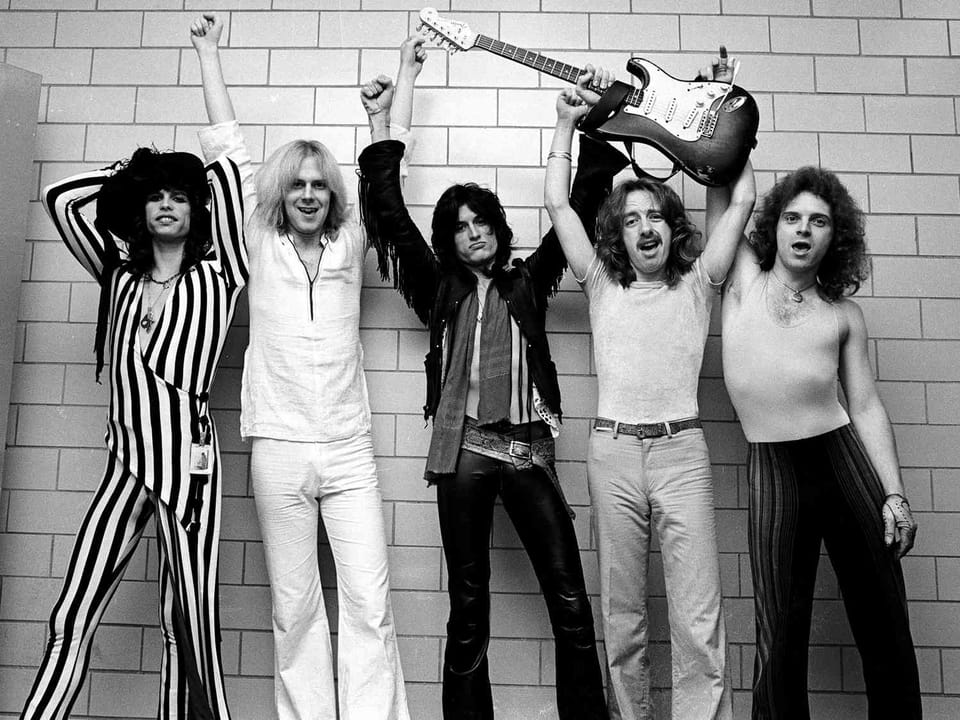
In the 1960s, England stole the blues from America, creating blues-rock. In the 1970s, Aerosmith returned the favor. Figuring their shit out from a crappy apartment in Boston, these five hard-working, hard-living young musicians combined the Stones’ Dionysian ruckus with Zeppelin’s Apollonian grandeur, cloaking the synthesis with homegrown trashiness. No matter how superhuman Aerosmith’s attack became, they always led with bathroom wall poetry.
I'm glad the distance of time means I don't have to choose between this and the Ramones.
Steven Tyler’s vocals are (were?) no less operatic than Freddie Mercury’s, and maybe even more difficult to imitate. It’s one thing to hit the high C, another to sound like a cat with their tail in a light socket, the resulting shriek somehow conveying enthusiasm more than agony. Despite levee-breaking and trampling underfeet with the best of ‘em, the guys behind Tyler came off less as self-styled vikings than hip dudes havin’ a blast. You couldn’t say they were playing dumb, not at this frenzied level of complicated whallop. But they were playing, delivering thrills for thrill’s sake, and fine with their meditative moments getting lost in the rush. While hard rock could sell literary fantasy, politics, topographic oceans and classical gas, Aerosmith said it all added up to showbiz, nothing mattering more than swagger and chutzpah. On that front, as the decades revealed, Aerosmith could only be defeated by themselves.
Their 1973 self-titled debut is impressive, if all too earthbound. Guitarists Joe Perry and Brad Whitford have hot licks, and the rhythm section of Tom Hamilton and Joey Kramer aspire to tricky bombast. “Make It” and “One Way Street” signal the impending whirlwind, and a climactic cover of Rufus Thomas’ “Walkin’ The Dog” shows silliness was already their secret weapon. But the outcome is still tentative, especially with Tyler holding his voice at a lower register. They sound like they hoped to upstage Alice Cooper on a good night for them, or a bad night for Alice. That original take on “Dream On" may always feel leaden if you heard the ‘90s live version on MTV first. Aerosmith showed a promising breadth of inspiration for a regional touring concern, but they hadn’t got their wings yet.
It's possible I overrated this in memory. That gong, though.
Wings were indeed gotten on Get Your Wings, accomplished engineer-now-producer Jack Douglas inspiring Aerosmith to experiment and aim higher. “Same Old Song And Dance” opens the album looser and more R&B than ever, that tier of novelty soon blown away by “Lord Of The Thighs,” a devilishly lean lurch where Tyler suggests a Robert Plant inspired by Penthouse Forum rather than Tolkien, but no less impish. “Thighs”’ closing coda, Tyler’s animalistic yelps and Perry’s guitar echoing in the distance while the band skitters around a piano drone, is where they really establish a sonic signature. Not only do they get away with covering “Train Kept A Rollin,” an early jump-blues/rock obscurity made famous by the Yardbirds and Led Zeppelin, they batter it so hard it would take Motorhead to bring it back to England. “Seasons Of Wither,” buried on the B, seems years ahead of its time. Tyler unveils that oddly excited ache now familiar from heavy rotation, over simple arpeggios and tight, proto-power ballad drama, the beauty ironically tying them to fellow college town anglophiles turned rock radio icons REM (who covered “Toys In The Attic”!). The songwriting flags on occasion, but the breakthroughs more than compensate.
Toys In The Attic is where they truly got nuts. Aerosmith bursts forth like nobody’s business on the title track, Tyler pulling behind and pushing forward with nagging, sly confidence. The band was now a collaborative riff machine, Tyler driven to new peaks of lyrical (“back when Cain was able/ way before the stable”) and vocal (“yayayayayaYOW!”) relish. Side A ends with “Big Ten Inch Record,” a jump blues they didn’t learn from an English act, but from Dr. Demento. This comfort with puerile humor pays even bigger dividends with “Walk This Way,” Tyler spitting out filthy sestains (look it up!) over a riff and cowbell so boisterous Run-DMC didn’t have to change a thing on their ’85 cover/collaboration (Tyler did take the opportunity to make the chorus less shouty). “Sweet Emotion” didn’t need rappers to be revived as a video hit in ’91, Douglas and the band experimenting with backmasking and marimba to provide an otherworldly level of horniness. Though the last numbers are merely respectively mammoth and misty-eyed, Toys In The Attic is in the running for best hard rock album of the ‘70s, American and actually popular division.
The same song as in the '91 Marty Callner video, earlier footage.
That '70s hard rock gold medal, however, goes to Rocks. “Back In The Saddle” has Aerosmith riding the crazy horses the Osmonds warned us about: whips crack, tubs thump and coconuts clop as they rampage though town and yodel into the sunset. For some reason, this was the first song I ever did at karaoke, a choice not unlike saving your virginity for prison. “Last Child” wistfully recalls being a “punk in the street” over a stripper-bait strut, “Rats In The Cellar” casually reminds you punk didn’t invent loud fast rules, and “Combination” rhymes “Yves St. Laurent” with “gaunt” despite being a solo Perry writing credit. Still, it’s the B side that’s staggering, with “Sick As A Dog” and “Lick And A Promise” darkly funny, oddly gorgeous tales of backstage madness and touring life, “Promise” in particular a feat of boogie-blitz levitation. The furious (and prescient!) eco-disaster warning of “Nobody’s Fault” might be the band’s finest ‘70s song not about getting laid, and the shrieking over slide guitar on “Home Tonight” is one majestic finale. You could say Rocks simply a shiny retread of Toys. You could also say you don’t need a cleaner, faster car with more extras for the same price. But here it is, and why turn it down?
Aerosmith has credited their striking initial evolution to being primarily focused on drugs and music at the time, a creative tunnel vision almost guaranteed to meet the oncoming train of real life. Draw The Line was the first album not to improve on the previous, but it benefits from being of the glory days, the wheels not having flown off entirely. The songs are less potent (rarely were Tyler and Perry excited about the same track), and the pummel more autopilot, but peak Aerosmith's inertia beats a lot of bands’ best showing. Draw The Line won’t put you in the mood for these guys, but won’t kill the mood either. Unless you play it right after Rocks (like fans once had to), or pay too much attention to “Kings And Queens,” Tyler’s failed attempt at Arthurian legend. Though the ‘73 covers on Side 4 are for die-hards, Live! Bootleg, a roughly-recorded double disc of the band at their most vicious and G’N’R-adjacent, does the era proud. Also foretelling Geffen Records: a ringer wrote the single.
More a highlight of Sgt. Peppers' Lonely Hearts Club Band than a highlight for Aerosmith.
Then came a collapse so cliche Tyler later swore Spinal Tap had been spying on them. Sales slipped, the wives were fighting, tours began before recording was finished, guitarists stormed off, titles became cries for help. First Jack Douglas left sessions for Draw The Line’s follow-up, then Joe Perry split after playing on only six tracks, starting a solo project to pay back a five-figure room service bill (uhh…). The music on Night In The Ruts is initially punchy and raw, particularly when Joe Perry is around to mesh with Brad Whitford. But Perry isn’t on the faceless Shangri-Las and Yardbirds covers, and the songs he does grace include such non-classics as “Cheese Cake,” “Bone To Bone (Coney Island White Fish Boy)” and “Reefer-Headed Woman,” another joke they learned from Dr. Demento. Ruts ends with an anguished, Perry-less tribute to the first daughter Tyler knew about, Bebe Buell not disclosing Liv Tyler’s true parentage for years. Though quite the big-seller, Greatest Hits is depressingly chronological, best for people who barely need a whole album of ‘70s Aerosmith in the first place.
The journey got darker still, Brad Whitford abandoning ship by the 1982 release of Rock In A Hard Place. Jack Douglas was back and the rhythm section earns their cut, but new guitarists Jimmy Crespo and Rick Dufay exist primarily for Tyler to lean on. Even here, at the band’s lowest, and his most catatonic, Tyler still tries to yabba-dabba-doo when appropriate. But evidence of his enduring vocal charisma, like the first half of “Joanie’s Butterfly,” only makes the tepid material more miserable. The opener is named “Jailbait,” the outsourced single opens with cornball synth, and each side ends with Tyler choking on a hairball. I’m not sure who would have won if Alice Cooper and Aerosmith played the same show around this time, but it wouldn’t have been the audience.
Did Joey Kramer grow the beard so fans would think he quit too?
Did Beantown’s best ever get it together, or would they slip further into tragic irrelevance? Odds are you know the answer, but I’ll still give my two cents on later product in Aerosmith, pt. 2!
Rocks is at 34 on My Top 400 Albums Of All Time. I'm telling you this because I've found people are more inclined to discuss and share reviews if there's a quantitative element at the top or bottom they can easily debate. Prove me right! If you need to wail in gratitude or outrage over something I wrote, shriek it off to anthonyisright at gmail dot com.